 VBIT Hong Kong


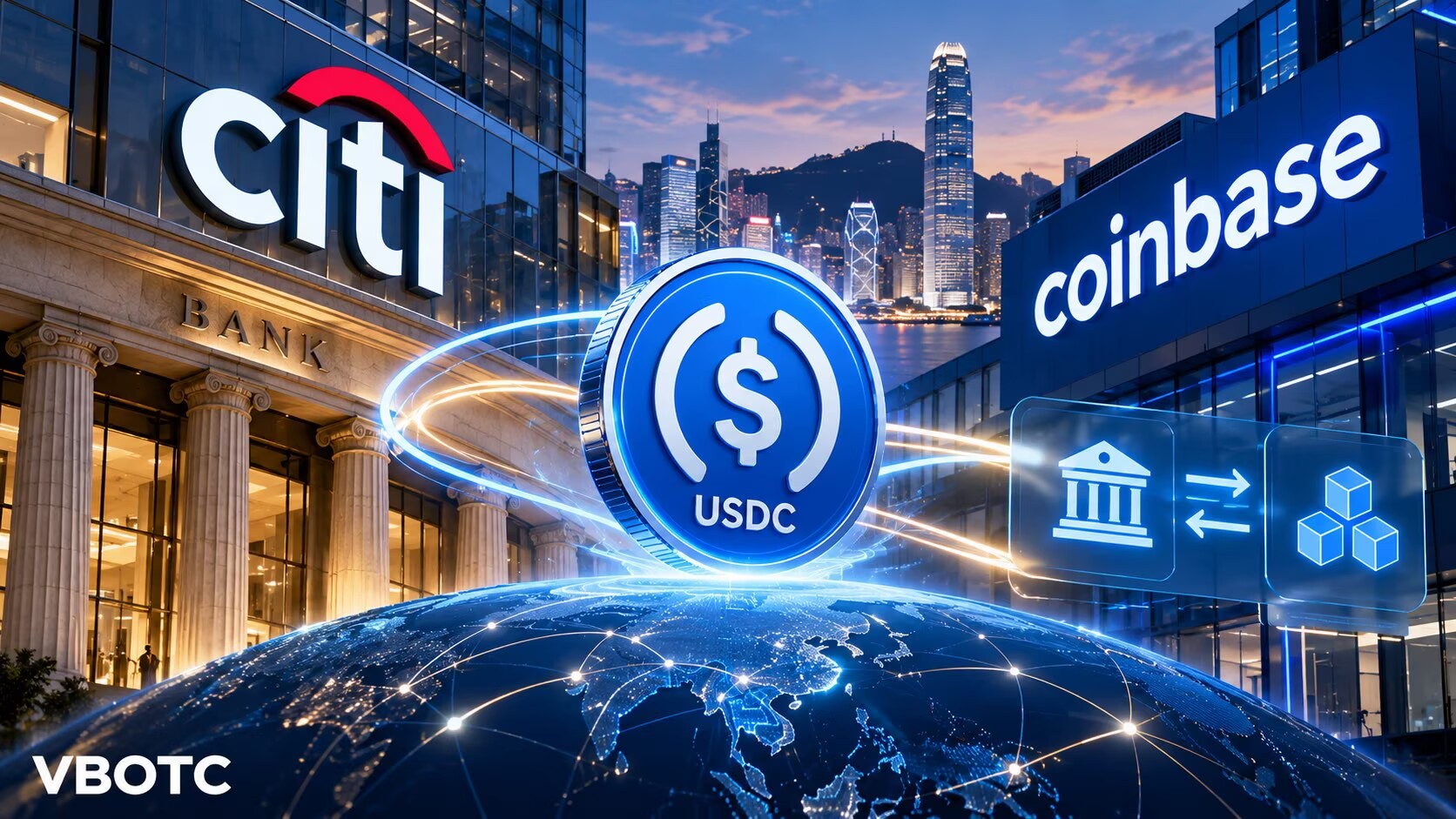
Introduction: Stablecoin competition moves from issuance towards payment gateways
Stablecoins are expanding beyond crypto trading into corporate payments, cross-border settlement and traditional banking. On 28 September 2026, Citi and Coinbase announced an expanded partnership to connect fiat banking more directly with stablecoin payment infrastructure.
The significance is not simply banks engaging with crypto, but stablecoins entering everyday corporate payments. Coinbase corporate clients can use Virtual Accounts supported by Citi to receive fiat and convert it automatically into stablecoins. Citi institutional clients can accept stablecoins through Spring by Citi, with Coinbase handling the digital-asset payment and conversion back into fiat for settlement.
As this model grows, competition may focus less on issuance volume and more on control of corporate payment gateways, banking access and settlement interfaces between digital assets and traditional finance.
1. What are Citi and Coinbase doing?
The expansion has two main directions. First, Coinbase Virtual Accounts uses Citi Services' Virtual Account Wallet as banking infrastructure, giving corporate customers bank-like capabilities to receive, hold and pay funds. Incoming fiat can be converted into stablecoins through Coinbase's payment system.
Second, Merchant Stablecoin Acceptance will let Citi institutional customers accept stablecoin payments through Spring by Citi. Coinbase Payments handles the stablecoin payment and conversion, while Citi settles merchants in fiat. Merchants can accept stablecoins without necessarily holding or managing them directly.
This reduces a longstanding corporate hurdle. Using banks alongside stablecoins previously required separate management of accounts, wallets, compliance, conversions and technical integrations. Citi and Coinbase aim to combine these into a more unified payment process.
Future competition may involve stablecoins plus banks rather than stablecoins versus banks.
2. Why is this more important than banks supporting crypto?
Earlier partnerships commonly focused on accounts, trading deposits and withdrawals, custody or institutional trading, chiefly helping funds enter digital-asset markets.
This partnership reaches corporate payments themselves. When stablecoins enter payments, receipts, settlement and treasury processes, they become closer to a payment rail than merely an exchange-traded digital asset.
For businesses researching stablecoin payments, the case is concrete: they need not abandon bank accounts or move entirely into crypto. They can add stablecoin capabilities to existing banking infrastructure, a likely route towards large-scale commercial adoption.
3. Why are companies interested in stablecoin cross-border payments?
Traditional international payments involve institutions, correspondent banks, foreign exchange and clearing. Large companies care not only about fees but also arrival times, continuous availability, cross-time-zone treasury management and the work needed for reconciliation and liquidity.
Blockchain stablecoins offer continuous transfers, programmability and traceability, attracting interest for cross-border payments, platform settlement, supplier payments and global e-commerce. Citi's announcement highlights rising demand for always-on, 24/7 financial services.
Stablecoins do not make every cross-border payment cheaper or immediate. Actual cost and efficiency still depend on network fees, fiat conversion, bank processing, AML checks, local regulation, liquidity and counterparties. The change is an additional route that can run alongside or integrate with banking.
4. Banks are absorbing blockchain infrastructure rather than simply being replaced
Early narratives often imagined disintermediation, but large institutions are retaining fiat accounts, compliance, clearing and customer relationships while incorporating blockchain, tokenisation and stablecoins as technologies and payment tools.
Citi supplies regulated banking infrastructure, fiat settlement and a global corporate network; Coinbase supplies stablecoins, on-chain payments and digital-asset technology. The partners connect different financial layers rather than competing in the same role.
Citi says its operations span over 180 countries and jurisdictions and handle about US$6 trillion daily. Connecting that network to stablecoin payments could matter far more than an additional feature on one crypto platform. The partnership will launch first in the United States, with further capabilities still to be developed.
5. What does this mean for Hong Kong stablecoins?
In 2026, Hong Kong has moved further into licensed stablecoin operations and regulatory implementation. HKMA guidance covers licensed issuers, banks and intermediaries, shifting attention from whether stablecoins are permitted to the frameworks governing their use.
The next step may depend less on the number of coins than on usable payment and settlement interfaces among banks, payment institutions, licensed issuers, platforms and corporate providers. Trade, e-commerce receipts, treasury management and RWA settlement may offer practical applications.
6. The connection between stablecoins and RWA may be more direct than expected
A large RWA market requires not only tokenised stocks, bonds, funds, gold and other assets but also funding that can pay and settle on-chain.
If payments still depend entirely on banking hours, remittances and layered clearing, tokenisation's efficiency gains are limited. Stablecoins, tokenised deposits and bank on-chain settlement tools could provide the cash leg of RWA.
That is why institutional digital-asset strategies often pair RWA and stablecoins: one brings assets on-chain, the other settles funds on-chain or across systems. Together they form more complete digital financial infrastructure.
7. Bank adoption makes distinguishing risks more important
Stablecoin payments do not remove risk. Issuers, reserves, redemption, jurisdictions and regulatory status differ. Corporate acceptance also depends on location, customer identity, KYC and AML requirements and bank policy.
Irreversible transfers, contract security, wallets, congestion and fiat-conversion liquidity remain practical concerns. Adoption should create sustainable compliance, risk and efficiency processes rather than focus solely on speed.
Bank participation is significant because technical and compliance complexity previously borne by individual businesses is increasingly shared by banks, licensed platforms and specialist payment infrastructure.
Conclusion: The next competition may concern control of fiat–stablecoin interfaces
Citi and Coinbase do not show that banking has entirely switched to stablecoins or that existing cross-border networks will be replaced. They do indicate a transition from internal crypto-market tools towards corporate payments and bank-grade infrastructure.
A valuable stablecoin ecosystem may be defined by its connections to bank accounts, corporate treasury, international payments, merchant receipts and RWA settlement rather than issuance alone. Providers making fiat-to-on-chain conversion compliant, low-friction and easy for businesses may control a key digital-finance gateway.
Hong Kong's next question is how licensed stablecoins can enter real banking, payment, RWA and cross-border commercial processes. Only when regulation, banks and blockchain payment infrastructure connect can stablecoins move from market concept towards financial infrastructure.
VBIT Hong Kong store enquiries
VBIT provides physical Crypto OTC services in Mong Kok, Tsim Sha Tsui, Causeway Bay and Kwun Tong. Trades are settled in HKD cash at our stores. USDT is available for cash out only; VBIT does not sell USDT to customers.
View store locations and contact VBIT or contact our official WhatsApp for a quote and an appointment.
