 VBIT Hong Kong


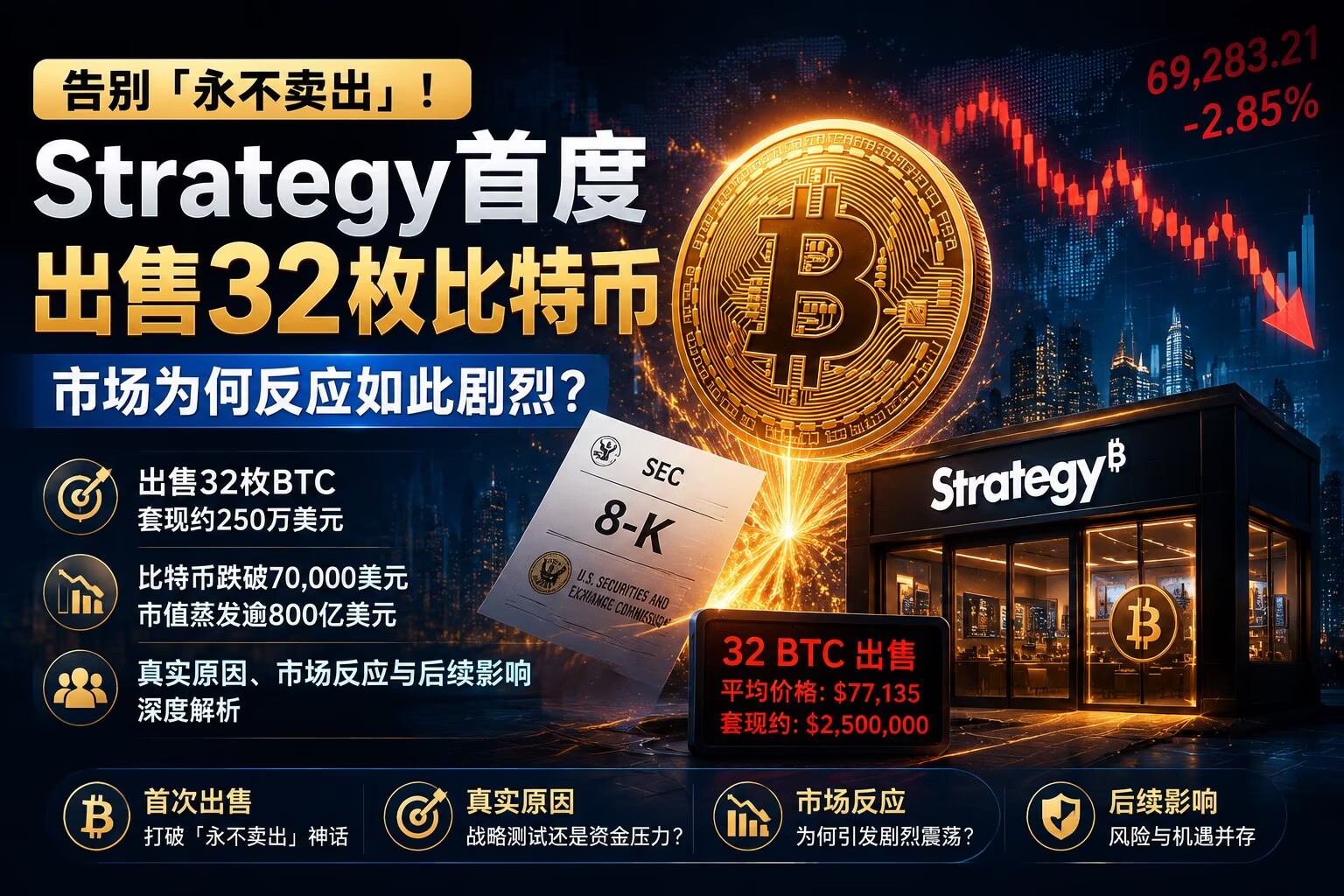
On 1 June 2026, Strategy, formerly MicroStrategy and the largest corporate Bitcoin holder, filed an 8-K with the SEC disclosing a transaction that shocked the market. Between 26 and 31 May, it sold 32 Bitcoin at an average US$77,135 each, raising about US$2.5 million.
It was Strategy's first Bitcoin sale since December 2022. Bitcoin subsequently fell below the psychological US$70,000 level, Strategy shares dropped nearly 10% at one point in a single day, and more than US$80 billion was erased from Bitcoin's market value.
The 32 coins represented only 0.004% of total holdings of 843,706 Bitcoin. Why did such a small sale provoke such a strong chain reaction?
1. The real reason for selling 32 BTC: A signal or funding pressure?
1.1 The stated reason: Preferred dividends
The SEC filing states that the approximately US$2.5 million proceeds will fund preferred-share distributions. Strategy operates several perpetual preferred series, including STRC with an 11.50% variable annual rate, STRF with a 10% fixed annual rate, euro-denominated STRE, STRK and STRD. STRC alone generates roughly US$80 million to US$90 million in monthly dividend obligations.
1.2 The deeper explanation: A strategic test and market signal
Why sell BTC for just US$2.5 million when US$900 million is available in reserve?
CEO Phong Le answered in a 13 June interview that it was a planned systems test. The aim was to acclimatise the market, verify internal Bitcoin-sale processes and build market resilience so future small strategic sales would not trigger panic.
Le said the sale was not caused by a cash shortage. It also generated a tax loss that could offset relevant tax liabilities, providing tax-planning value.
During the same week, Strategy raised US$128.3 million through at-the-market (ATM) equity sales, 50 times the Bitcoin-sale proceeds. The 32-BTC sale therefore looks more like a deliberate stress test than a genuine need for working capital.
1.3 A new strategic framework: From buying only to following the maths
At an early-May earnings call, Phong Le said the goal remained to be a net Bitcoin accumulator, but increasing Bitcoin per share was more important.
Le described a framework based on maths rather than ideology: sell Bitcoin if doing so increases Bitcoin per common share, or issue equity if that is more accretive. Strategy also introduced the income security STRC in May, aiming to turn its Bitcoin reserves into a credit engine that creates financing capacity by meeting demand for yield products.
2. Why did the market react so strongly to 32 BTC?
2.1 Symbolism outweighs the amount
The 32 BTC represent only 0.004% of total holdings. Wave Digital Assets' portfolio head said the move had fundamentally shaken belief in chairman Michael Saylor's never-sell position.
Crypto analyst Phyrex said: "Thirty-two coins are insignificant in quantity, but the sale damaged the confidence of many investors. Saylor originally promised never to sell Bitcoin. Once that promise is broken, the number is no longer the most important issue."
BITWU.ETH added that the short-term fall was not caused by the actual selling pressure, but by repricing the expectation of a permanent one-way buyer. For six years, Strategy had been seen as a buyer that never sold, underpinning much of the bullish narrative. The first crack in that image requires the market to reassess a variable it had never seriously quantified.
2.2 Could the sale trigger a selling chain reaction?
The real fear is that prolonged price weakness could make small sales routine, creating a vicious cycle of falling shares, pressure on leveraged products and forced disposals.
On 31 May 2026, Strategy held 843,706 Bitcoin at a total cost of about US$63.87 billion and an average US$75,699 per coin. At roughly US$62,000 in mid-June, unrealised losses were around US$14 billion. Annual cash preferred dividends of about US$1.7 billion compared with roughly US$1.4 billion in cash reserves, enough for around ten months.
Arca chief investment officer Jeff Dorman said Strategy's preferred-share financing structure was out of control and increasingly difficult to sustain amid Bitcoin volatility.
2.3 Saylor responds: Never selling was personal advice
Responding at BTC Prague 2026 on 11 June, Michael Saylor said: "I said YOU should never sell your Bitcoin."
He clarified that he had advised individual investors not to sell, but had never said the company could never sell. Anyone following Strategy's earnings calls or disclosures over the past five years, he said, would know it could sell when necessary.
Saylor said he would not damage the company's financial health because of users' criticism and that sales were possible if needed. He attributed Bitcoin weakness to global capital rotation, with about US$400 billion moving towards IPOs of major technology companies such as OpenAI, Google and SpaceX, prompting sales of assets including Bitcoin.
3. What followed: A tactical exercise, with long-term net accumulation still the aim
3.1 Buying 1,550 BTC after the sale
After the small late-May sale, Strategy made a larger purchase: between 1 and 7 June, it bought 1,550 Bitcoin for about US$101.3 million, raising total holdings to 845,256 and US-dollar reserves to US$1 billion.
Phong Le stressed that the 32-Bitcoin sale should not be interpreted as a need to use Bitcoin to fund preferred dividends. The long-term objective remains continued net growth in holdings.
3.2 Structural risks remain
Despite the tactical-test explanation, structural pressures remain. STRC preferred shares have fallen to US$75, a 25% discount to US$100 par value. This discount effectively closes the financing loop behind most of Strategy's Bitcoin purchases in 2026.
Restarting that loop would require MSTR to recover above about US$183, corresponding to Bitcoin moving towards US$91,500.
Positively, most Strategy debt is long term and has no margin-call clauses, so lenders cannot force liquidation simply because Bitcoin falls. The immediate pressure is cash dividends rather than debt maturities.
4. Lessons for high-net-worth clients: Crypto liquidity and channel security
VBIT Hong Kong store enquiries
VBIT provides physical Crypto OTC services in Mong Kok, Tsim Sha Tsui, Causeway Bay and Kwun Tong. Trades are settled in HKD cash at our stores. USDT is available for cash out only; VBIT does not sell USDT to customers.
View store locations and contact VBIT or contact our official WhatsApp for a quote and an appointment.
