 VBIT Hong Kong


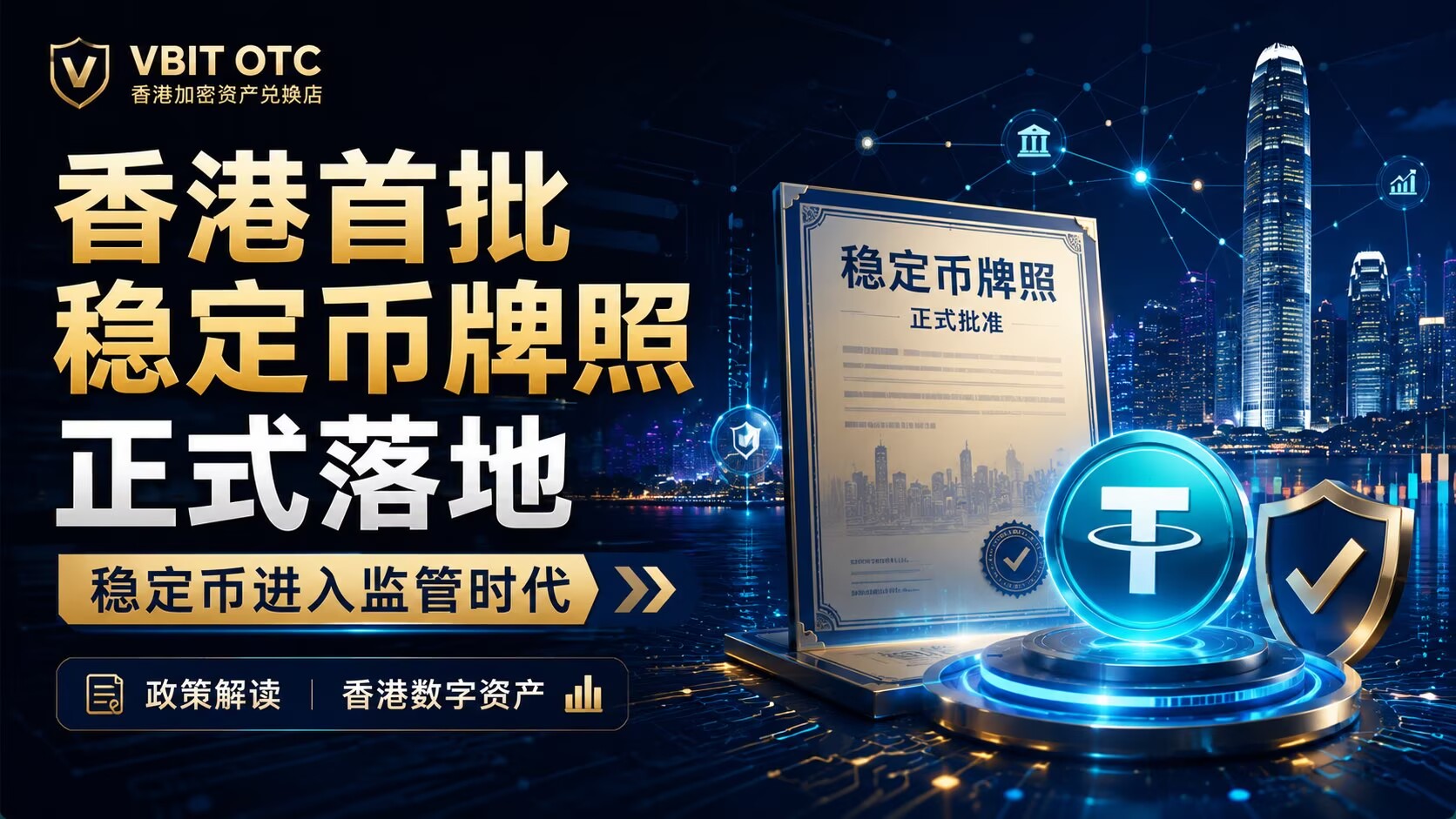
Hong Kong's First Stablecoin Licences: What the New Regulatory Era Means for Ordinary Users
Hong Kong's digital-asset market has reached an important milestone.
On 10 April 2026, the HKMA announced its first stablecoin-issuer licences. According to its published information, Anchorpoint Financial Limited and The Hongkong and Shanghai Banking Corporation Limited became the first licensees, with the licences effective that day.
This was not a policy introduced without preparation.
Hong Kong's Stablecoins Ordinance took effect on 1 August 2025, establishing regulation of fiat-referenced stablecoin issuers. After months of applications, reviews and preparation, 2026 marks the transition from setting up the system to actual licensed operation.
This may matter more to ordinary crypto-asset users than it first appears.
It means stablecoin discussions in Hong Kong increasingly go beyond asking:
"What is this coin worth?"
They also ask:
"Who issues it, who regulates it, and through which channel is it traded?"
1. Why does Hong Kong license stablecoin issuers?
Unlike more volatile crypto assets such as Bitcoin and Ethereum, stablecoins are generally designed to maintain a relatively stable value, for example by referencing fiat currencies such as USD or HKD.
They are therefore increasingly discussed for payments, settlement and cross-border fund flows as well as crypto trading.
At Consensus Hong Kong in February 2026, Financial Secretary Paul Chan described stablecoins as a potential tool for addressing payment and settlement problems in the real economy. Regulatory priorities include genuine use cases, credible and sustainable business models and sufficient compliance capabilities.
In other words:
Hong Kong aims not simply to create more stablecoins, but to incorporate them gradually into a financial framework with supervision, accountability and risk management.
That is the most significant aspect of issuer licensing.
2. Thirty-six applications, only two initial licensees
The application count is another noteworthy feature.
The HKMA said that by the first application deadline it had received submissions from 36 institutions, while only two initial licensees were announced in April 2026.
This reflects a relatively cautious approach to licensing.
A stablecoin may look like a blockchain token, but using it for payments and settlement involves many issues faced by traditional financial institutions: reserve management, redemption, risk controls, customer-asset protection, AML and operational security.
Therefore:
Stability should apply not only to the price but also to the issuance and management mechanisms behind it.
3. Do Hong Kong's licences mean all stablecoins are licensed?
No.
This is a particularly common source of confusion.
Establishing an issuer-licensing regime does not automatically license every existing stablecoin in the market.
The HKMA maintains a Stablecoins Ordinance register where the public can check licensees' names, licence numbers, effective dates and related information.
When you see claims such as:
"Hong Kong stablecoin"
"Hong Kong-compliant stablecoin"
"Hong Kong-licensed stablecoin"
the simplest check is not to rely on the advertisement, but to:
Consult the HKMA's official register directly.
A key change in the regulated era is the need to distinguish marketing claims from regulatory status.
4. How does USDT relate to Hong Kong stablecoin licensing?
This is a major concern for many Hong Kong crypto-asset users.
USDT is a stablecoin intended to maintain a 1:1 reference relationship between each USD₮ and the US dollar, circulating across several blockchain networks.
However:
USDT being a stablecoin and Hong Kong having a stablecoin-issuer licensing regime are separate concepts.
The first licences do not imply that every USDT transaction is a Hong Kong-licensed stablecoin activity.
Whether a stablecoin is regulated as the product of a Hong Kong-licensed issuer should be checked against the HKMA's latest register and regulatory information. Its published initial licensees are Anchorpoint Financial Limited and The Hongkong and Shanghai Banking Corporation Limited.
Ordinary users do not need to memorise every regulatory rule.
Remember one principle:
The currency, its issuer and the trading channel are separate matters.
They should not be conflated.
5. Hong Kong's digital assets are moving beyond buying and selling towards a fuller financial system
Over a longer horizon, stablecoin licensing is only one part of the regulatory landscape.
Hong Kong has advanced regulation of virtual-asset platforms, tokenised assets, digital bonds, stablecoins and digital-asset custody in recent years.
By the end of 2025, digital assets held in custody by Hong Kong's banking system exceeded HK$14 billion, up approximately 180% year on year, while banks' tokenised-deposit services reached about HK$29 billion。
In 2026, the framework continues extending into virtual-asset dealing, custody, financing and stablecoin-related activities. In May 2026, Hong Kong financial regulators issued further guidance on stablecoin-related virtual-asset activities, digital-asset custody and virtual-asset dealing.
Together, these changes point to a trend:
Hong Kong's digital-asset market is evolving from simple cryptocurrency buying and selling into an ecosystem encompassing issuance, trading, custody, settlement and asset management.
6. For ordinary users, the biggest change is compliance awareness
Many people first ask these questions about stablecoins:
What is the exchange rate?
What are the fees?
How long will the transfer take?
Which network costs least?
These questions matter.
As Hong Kong's regulation develops, however, other questions are becoming more important:
Who is the counterparty?
Where do the funds come from?
Does the platform or institution actually hold the regulatory status it claims?
Has the wallet address been verified?
Are transaction records complete?
Are KYC and AML checks required?
Particularly for larger exchanges, speed should not be the only consideration.
Knowing the counterparty, retaining records and understanding fund provenance matter equally.
7. What does stronger stablecoin regulation mean for Hong Kong OTC?
Stablecoin licensing principally regulates issuance-related activities; it is not equivalent to all crypto-asset exchange businesses.
The broader market signal is nevertheless clear:
Identity transparency, source-of-funds checks, transaction records and AML requirements will become more important.
OTC users should therefore look beyond a small difference in quotes or a few minutes saved on a transfer.
For large trades, confirm procedures, required information, payment arrangements and wallet addresses in advance.
Security often depends not simply on whether cryptocurrency arrives, but on whether the complete fund flow is clear.
VBIT Hong Kong store enquiries
VBIT provides physical Crypto OTC services in Mong Kok, Tsim Sha Tsui, Causeway Bay and Kwun Tong. Trades are settled in HKD cash at our stores. USDT is available for cash out only; VBIT does not sell USDT to customers.
View store locations and contact VBIT or contact our official WhatsApp for a quote and an appointment.
