 VBIT Hong Kong


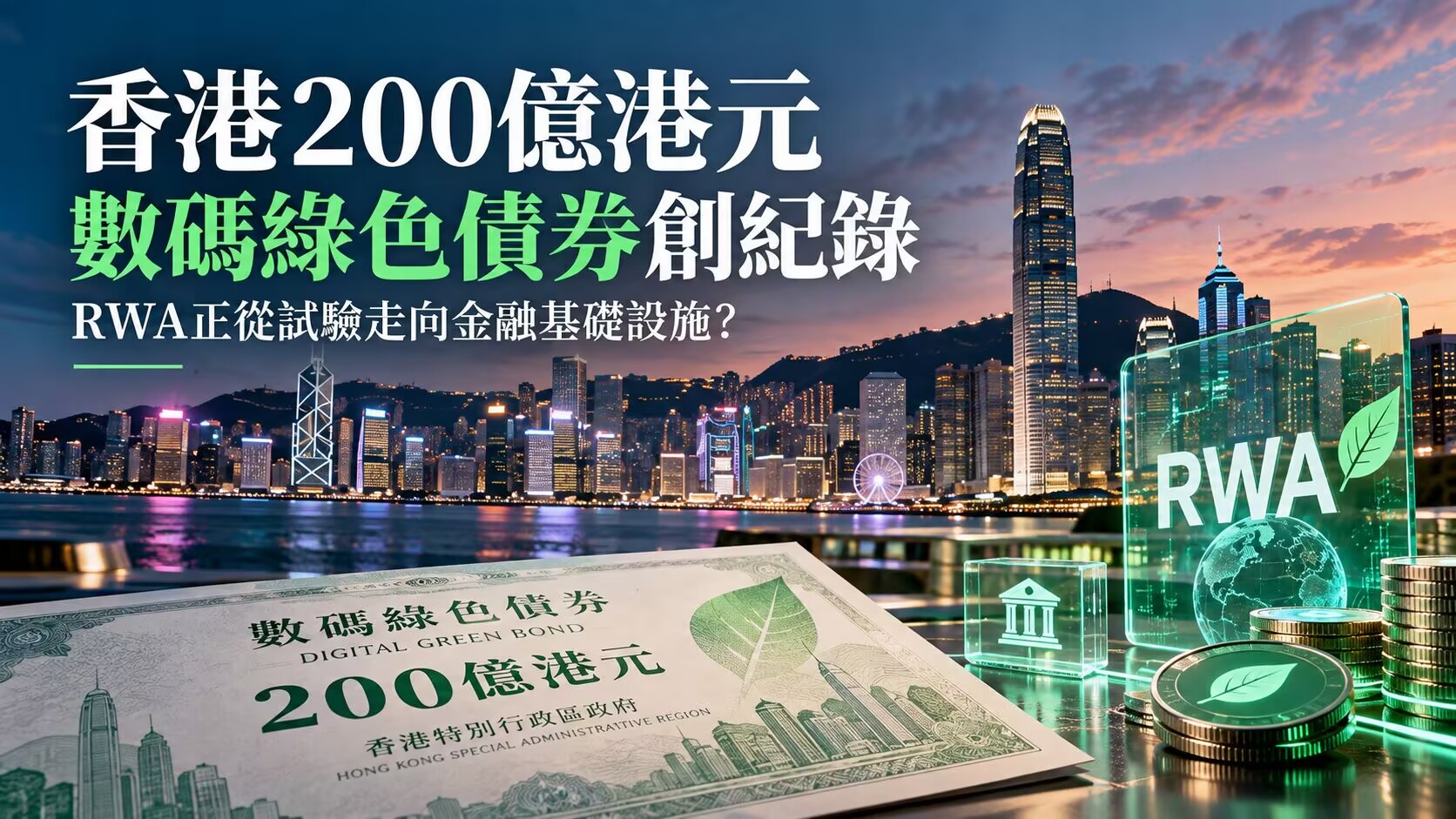
A noteworthy change is emerging in Hong Kong's real-world asset market.
Past RWA discussions focused on which assets could go on-chain and whether tokenisation had practical value. In 2026, Hong Kong is integrating digital bonds, tokenised deposits and digital-currency settlement into existing finance.
On 29 September 2026, the Hong Kong government announced successful pricing of approximately HK$20 billion equivalent in digital green bonds under its Sustainable Bond Programme. The HKD, RMB, USD and EUR issuance set another record as the world's largest digital-bond issue.
Its settlement method deserves even more RWA attention than its size.
For the first time, tokenised deposits were introduced through EnsembleTX into primary settlement of HKD bonds. Tokenisation is extending beyond putting bonds on blockchains towards bringing both assets and money into a tokenised system.
Why does a HK$20 billion digital-bond issue matter?
Digital bonds remain bonds.
Investors still buy assets with an issuer, maturity, interest and repayment terms. Distributed ledger technology (DLT) handles parts of issuance, registration, settlement and management.
Digital bonds are therefore different from common cryptocurrencies.
Their significance for RWA is that traditional assets are using blockchain and tokenisation infrastructure.
This issue is distinctive because its scale has moved beyond early experimentation.
Approximately HK$20 billion across four currencies makes it closer to a large conventional international bond issue than a small blockchain proof of concept (PoC).
The government said the issue was oversubscribed, indicating real demand for Hong Kong tokenised financial products.
The RWA question is shifting from whether the technology works to how it can be used at scale.
A greater breakthrough: Tokenised deposits enter bond settlement
Hong Kong has issued digital bonds before.
The new element is tokenised deposits.
Traditional asset trades use separate systems: securities are registered in securities infrastructure while funds move through bank payment and settlement networks.
Even a tokenised bond remains limited in immediate delivery, automation and programmability if payment relies entirely on conventional infrastructure.
Using EnsembleTX tokenised deposits for HKD primary-bond settlement addresses that gap. The government describes the bonds as among the first globally to incorporate HKD tokenised deposits, laying foundations for exploring programmable digital currency.
Previously, RWA often meant on-chain assets plus conventional money settlement.
A more complete future model could combine tokenised assets, tokenised money and on-chain settlement.
What appears to be a payment-method change is important for the entire financial market.
When assets and funds settle digitally, delivery versus payment (DvP), automated settlement, 24/7 fund operations and further smart-contract applications become theoretically possible.
RWA then involves redesigning financial infrastructure rather than simply turning an asset into a token.
Hong Kong is making digital bonds a regular financial instrument
The route becomes clearer when the HK$20 billion issue is considered alongside 2026 policy.
The 2026 Policy Address states that Hong Kong accounted for about half of global digital-bond issuance from 2025 through the first half of 2026. The government plans regular issuance and will explore digital currencies across settlement, interest payments and redemption.
The aim is to make digital bonds a routine fixed-income instrument rather than repeat an experiment.
Tokenising Exchange Fund Bills may be the next market to watch.
The HKMA plans tests before the end of 2026. With more than HK$1.3 trillion in Exchange Fund Bills outstanding, one objective is to help banks use these assets around the clock for balance-sheet management.
Bringing large, liquid assets into tokenised markets could shift Hong Kong from issuing individual products towards building a digital-asset market institutions can use at scale.
RWA's next phase may be financial infrastructure rather than more tokens
Common RWA topics have included property, US Treasuries, gold and tokenised funds.
Hong Kong's recent developments offer another perspective.
Mainstream adoption may depend less on how many assets can be tokenised than on whether custody, cash settlement, law, trading platforms and clearing combine into complete infrastructure.
Hong Kong is advancing several components simultaneously.
These include regular digital bonds, tokenised deposits, CBDC settlement, tokenised Exchange Fund Bills and digital-asset platforms.
The 2026 Policy Address also targets EnsembleTX CBDC settlement and 24/7 operations around year-end, alongside further tokenised-deposit applications.
Connected together, these could create tokenised infrastructure integrated with banks, bonds, funds and capital markets rather than a separate crypto-finance market.
This may be RWA's more significant long-term potential.
Could Hong Kong become Asia's RWA financial centre?
Singapore, Dubai, the United States and European centres are also accelerating tokenisation, so Hong Kong is not alone.
Its distinctive position combines mature banking, offshore renminbi, international bond markets and institutional investors with regulation of virtual assets, stablecoins and tokenised financial products.
The question is not just how many tokenised products appear, but whether they connect with bank funding, bonds and cross-border finance.
The approximately HK$20 billion digital green bonds may be an important milestone.
Digital bonds are moving from technical pilots to large issues, while tokenised deposits enter real transactions. If Exchange Fund Bills, funds, gold and other assets follow, Hong Kong RWA could move from product innovation towards infrastructure competition.
The industry's question is consequently changing: will future markets merely move traditional assets onto blockchains, or develop new infrastructure in which assets, money and settlement are all digital?
Hong Kong is attempting to provide its own answer.
VBIT Hong Kong store enquiries
VBIT provides physical Crypto OTC services in Mong Kok, Tsim Sha Tsui, Causeway Bay and Kwun Tong. Trades are settled in HKD cash at our stores. USDT is available for cash out only; VBIT does not sell USDT to customers.
View store locations and contact VBIT or contact our official WhatsApp for a quote and an appointment.
