 VBIT Hong Kong


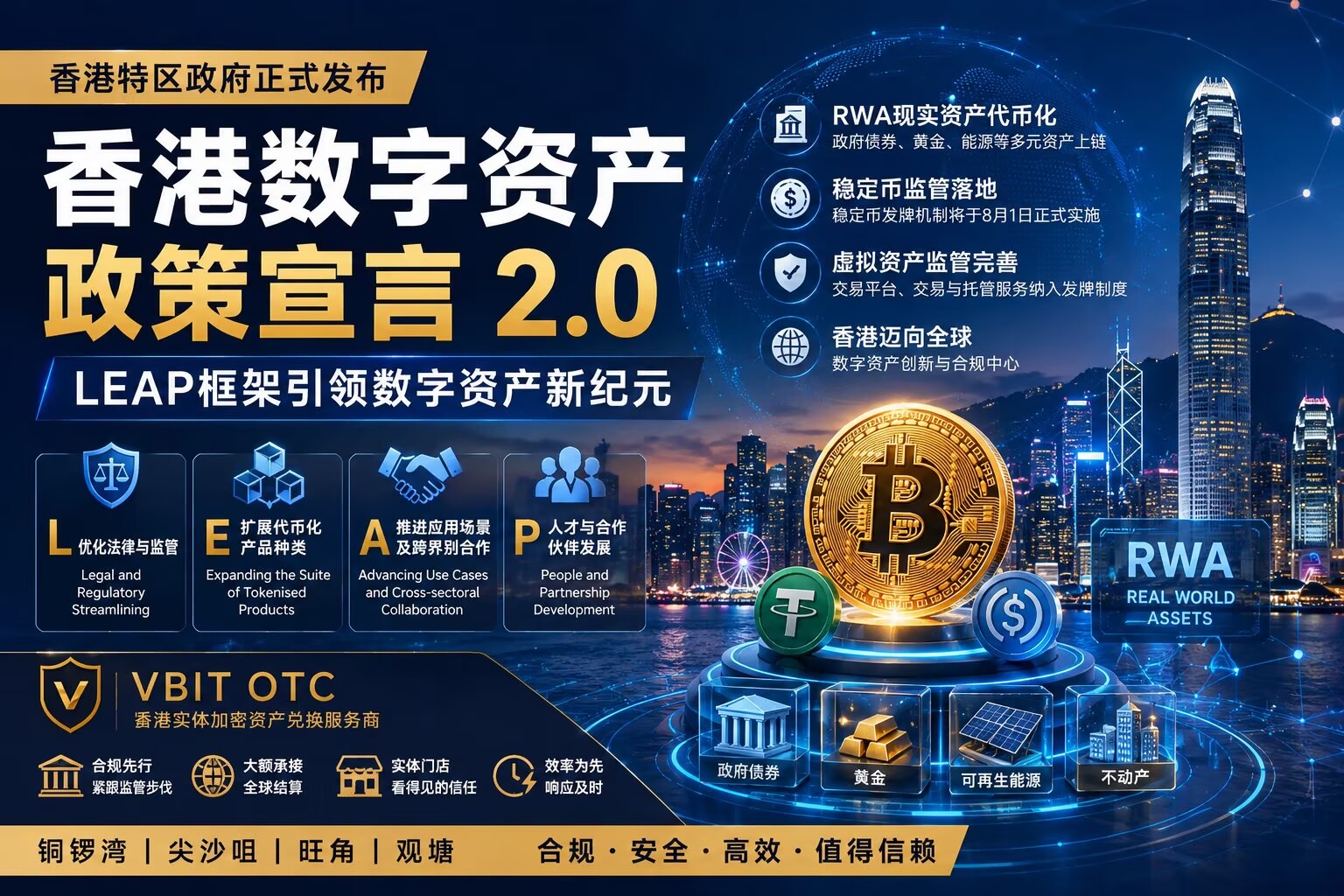
The Hong Kong government has issued Policy Statement 2.0 on the Development of Digital Assets in Hong Kong. Building on its first statement in October 2022, it further sets out the vision for a trusted and innovative digital-asset ecosystem.
Financial Secretary Paul Chan said: "Digital assets are an important and highly promising part of fintech. Blockchain enables more efficient, lower-cost financial transactions and more inclusive services." Secretary for Financial Services and the Treasury Christopher Hui said Hong Kong's strengths put it in a leading position to help traditional finance enter the digital-asset era, and that Policy Statement 2.0 provides a framework for a trusted, sustainable ecosystem closely integrated with the real economy.
1. The core of Policy Statement 2.0: Four pillars of LEAP
The statement introduces LEAP, a framework with four development pillars:
— Legal and Regulatory Streamlining
The government is developing a unified, comprehensive framework for four types of digital-asset service provider: trading platforms, stablecoin issuers, dealing service providers and custody service providers.
The Securities and Futures Commission will be the principal regulator for future licensing regimes covering digital-asset dealing and custody services.
The FSTB and HKMA will lead a comprehensive legislative review to facilitate tokenisation of real-world assets and financial instruments. It will examine the full process of issuing and trading tokenised bonds, including settlement, registration and record-keeping. The FSTB and SFC will soon consult publicly on dealing and custody licensing.
The FSTB aims to introduce legislation in 2026 placing virtual-asset advisory and management services under mandatory licensing. Together with existing trading-platform and stablecoin-issuer regimes and proposed dealing and custody rules, this would connect the ecosystem's main nodes into a system as trusted and sustainable as traditional finance.
E — Expanding the Suite of Tokenised Products
The government announced several concrete measures to broaden tokenised products:
1. Regular tokenised government-bond issuance to institutionalise RWA development
Making tokenised government-bond issuance regular marks a transition from pilots to established practice. The government will also incentivise RWA tokenisation, including clarifying stamp-duty arrangements for tokenised exchange-traded funds to improve liquidity and accessibility.
2. Secondary-market trading in tokenised assets to improve liquidity
The government welcomes future secondary trading of such tokenised ETFs on licensed digital-asset trading platforms or other platforms. This connects issuance and trading, allowing investors to trade tokenised products through compliant platforms with substantially better liquidity.
3. Tokenisation of gold, metals, renewable energy and other assets
The government will promote broader tokenisation of assets and financial instruments to demonstrate applications across sectors, including precious metals such as gold, non-ferrous metals and renewable energy such as solar panels.
A — Advancing Use Cases and Cross-Sectoral Collaboration
Measures to advance use cases include:
· Stablecoin licensing: The issuer-licensing regime will take effect on 1 August to support practical applications.
· Government-led stablecoin trials: To demonstrate support and leadership, the government welcomes proposals on how it could test and use licensed stablecoins.
· Cyberport pilot subsidies: Cyberport will launch a blockchain and digital-asset pilot subsidy scheme to fund projects with future application potential, demonstrative value and market impact.
— People and Partnership Development
The government will work with industry and academia to develop talent and position Hong Kong as a centre for digital-asset knowledge sharing and international partnerships, including joint research and global regulatory cooperation. Training a new generation of entrepreneurs, researchers and technology specialists will build a sustainable talent pool.
2. Implications for investors and market development
1. Greater regulatory certainty for Hong Kong virtual assets
Policy Statement 2.0 establishes a clear regulatory pathway for digital-asset service providers. With the SFC consulting on dealing and custody licensing, businesses will have clearer legal status and compliance frameworks. For investors, this means a safer trading environment and stronger asset protection.
2. Continuing investment opportunities in tokenised RWAs
Regular tokenised government-bond issuance and the tokenisation of precious metals and renewable energy could give investors compliant access to previously difficult-to-reach asset classes, helping diversify portfolios.
3. Faster development of stablecoin applications
When licensing takes effect on 1 August, compliant stablecoins will have lawful Hong Kong use cases. They provide new payment and settlement infrastructure as well as safer, more transparent fund-flow channels for high-net-worth clients.
3. Hong Kong's digital-asset compliance era: New options for large funding needs and OTC services
The policy statement was issued on 26 June 2025. Read the government announcement for its LEAP framework and stablecoin development context.
VBIT Hong Kong store enquiries
VBIT provides physical Crypto OTC services in Mong Kok, Tsim Sha Tsui, Causeway Bay and Kwun Tong. Trades are settled in HKD cash at our stores. USDT is available for cash out only; VBIT does not sell USDT to customers.
View store locations and contact VBIT or contact our official WhatsApp for a quote and an appointment.
