 VBIT Hong Kong


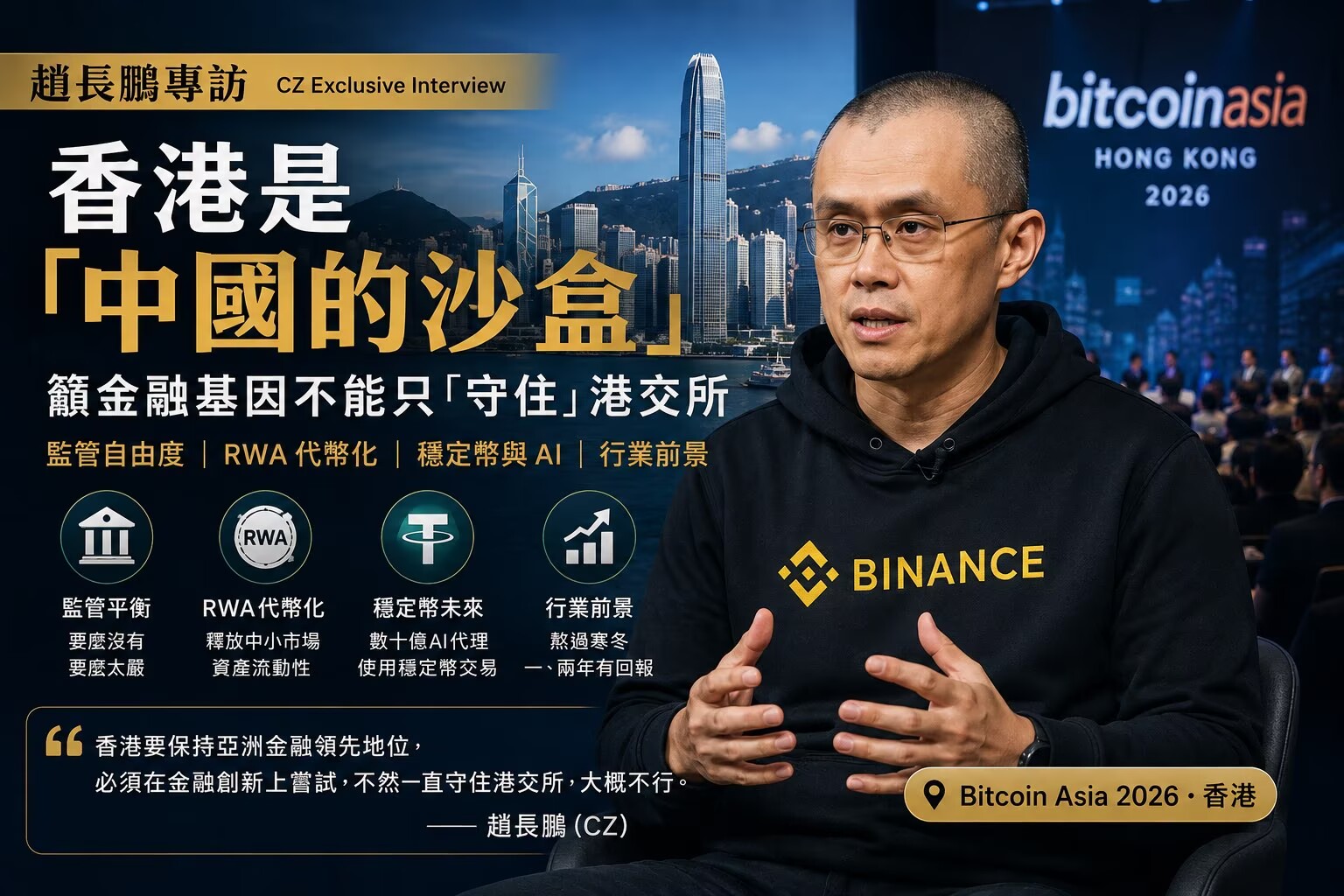
In early September 2026, Bitcoin Asia 2026 took place at the Hong Kong Convention and Exhibition Centre. Binance founder Changpeng Zhao (CZ) attended and gave an interview to HK01. Having experienced US federal prison and regained his freedom, he offered views on Hong Kong's Web3 strategy, regulation and industry prospects.
1. Hong Kong as China's sandbox: More than protecting HKEX
For the founder of the world's largest crypto exchange, regulatory friendliness determines where to operate. In his autobiography, Zhao recalls receiving Dubai's golden visa within 12 hours, compared with nine months to obtain a Singapore work visa.
How does he view Hong Kong?
Zhao says China currently lacks clear digital-currency rules, while Hong Kong has explored financial innovation through stablecoin and exchange licensing since last year. He describes Hong Kong's thinking as progressive and sees it as a leading sandbox for China's digital-currency experiments, well suited to financial innovation and Web3.
He also says retaining Asia's financial leadership requires more than traditional thinking:
"Hong Kong must experiment with financial innovation to stay ahead in Asia. Simply protecting HKEX probably will not be enough."
HKEX is a cornerstone of Hong Kong finance, but defending an existing position does not guarantee leadership as Web3 and digital assets spread. Hong Kong needs proactive innovation rather than preserving the status quo.
2. More regulatory flexibility: Either no regulation or too much
Zhao's praise is conditional. Hong Kong's financial strengths must be balanced with innovation:
"There needs to be more regulatory freedom. At present, there is either no regulation or regulation is too strict. A balance is needed."
Hong Kong has rapidly built its framework, launching virtual-asset trading platform (VATP) licensing in 2023 and bringing the Stablecoins Ordinance into effect in August 2025. Yet businesses report high compliance costs, lengthy approvals and insufficient operational guidance for some requirements.
His criticism is a reminder that regulation should support healthy development rather than stifle innovation. Excessive controls may push talent and capital towards more welcoming jurisdictions, as his own choice of operating base illustrates.
He regards the UAE as the most advanced, the United States as progressing in stablecoin and exchange regulation, Japan as active, Hong Kong as moving quickly and Singapore as relatively conservative. This both recognises Hong Kong's progress and challenges it: it may be ahead of Singapore, but the UAE leads globally.
3. RWA tokenisation: Unlocking liquidity in smaller markets
Zhao is particularly optimistic about real-world asset tokenisation.
Putting assets on-chain can overcome time-zone and cross-border limits and connect them to global markets. Assets constrained by geography, size or regulation, such as SME receivables, regional property or commodity inventories, could attract global investors and funding through tokenisation.
He describes RWA as a financial model bringing physical assets onto blockchains to improve liquidity and transparency. Traditional equities face account-opening barriers, trading hours and cross-border fund restrictions, whereas tokenisation could theoretically allow participation from anywhere.
Hong Kong has particular advantages: substantial real-world assets in property, bonds, trade finance and art. Tokenisation could make it a global RWA trading and settlement hub.
This aligns with HKMA tokenised-bond initiatives, Project Ensemble and the LEAP framework in Policy Statement 2.0. Zhao's support further highlights RWA's strategic value.
4. AI and cryptocurrency: An irreversible convergence
Zhao says AI is not necessarily Hong Kong's strongest area:
"Hong Kong is not really an internet-industry base, so it may not be the best place for AI."
He sees Taiwan's semiconductor industry as an AI advantage, while stressing that different regional strengths do not create a simple either-or choice.
He nevertheless regards AI and cryptocurrency convergence as irreversible. Billions of AI agents conducting automated purchases, negotiations and transactions will use cryptocurrency, he predicts, probably starting with stablecoins and later incorporating Bitcoin and other public-chain assets.
This suggests a future in which AI agents exchange value directly through blockchains rather than traditional financial infrastructure. Stablecoins could form the monetary base of an AI economy, while Bitcoin and similar assets serve as stores of value.
For Hong Kong, stablecoins therefore have strategic significance beyond current payments, potentially supporting future AI infrastructure. Compliant HKD stablecoins such as HKDAP are laying foundations for that future.
5. Nearly 200 investments in six months, 80% focused on Web3
Zhao says he now supports early-stage projects mainly through YZiLabs, continuing to invest during weak markets. Almost 200 projects received investment over the past six months, about 80% in Web3 and 20% in AI.
He believes crypto has passed the harshest winter and fundamentals remain healthy. Decentralised exchanges have developed for eight years, with more mature technology and user understanding. Further regulatory easing could support stronger growth.
He remains optimistic about returns: "I believe the next year or two will deliver good returns."
The 200-project portfolio reflects an emphasis on both infrastructure and applications, led by Web3 with AI as a complement. It offers a reference point for high-net-worth clients following Web3 investment.
6. Implications for Hong Kong high-net-worth clients
The interview sends three clear signals:
First, Hong Kong's regulatory direction is right, but more flexibility is needed.The sandbox role could make Hong Kong a global Web3 testing ground, but excessive restrictions may drive away talent and capital. Compliant services will continue developing, while near-term policy uncertainty remains.
Second, RWA tokenisation is a relatively well-defined long-term opportunity.With Zhao's support and the HKMA's institutional work, RWA is moving from concept towards scale. Clients wishing to participate first need compliant funding and cash-out channels.
Third, stablecoins are infrastructure for the future AI economy.HKD stablecoins matter beyond payments, potentially serving billions of AI agents. HKDAP is a starting point for an ecosystem with substantial long-term possibilities.
VBIT Hong Kong store enquiries
VBIT provides physical Crypto OTC services in Mong Kok, Tsim Sha Tsui, Causeway Bay and Kwun Tong. Trades are settled in HKD cash at our stores. USDT is available for cash out only; VBIT does not sell USDT to customers.
View store locations and contact VBIT or contact our official WhatsApp for a quote and an appointment.
